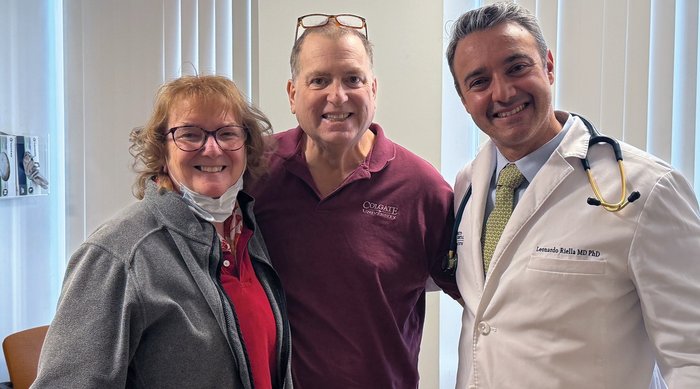
Dr Riella has overseen three xenotransplants to date, including one given to 67-year old Timothy Andrews in January 2025.
Xenotransplant research has been going on for over 40 years . . . Here at MGH, there have been researchers working since the 1980s transplanting pig kidneys into non-human primates. They've done all the pre-clinical work, but for the first 30 years, progress was very slow. These kidneys would not last more than a few days.
In 2014, researchers started using CRISPR-Cas gene editing, a gene-editing technology that allows scientists to precisely alter DNA sequences in living organisms.
By modifying the genomes in the pig kidney, we could overcome some of the immunological incompatibilities that we know exist between humans and pigs . . . It also helps minimise potential infections and viruses which are inside the pig’s DNA, called PERVs, or porcine endogenous retroviruses.
In theory, these viruses could be transmitted to humans, so editing out harmful genes is a key element of xenotransplantation. The US regulatory body, the Food and Drug Administration (FDA), started to consider ‘compassionate use’ for xenotransplantation.
This is a regulated path which allows us to test a drug that hasn’t been used on humans . . . for a patient with a life-threatening condition, where we believe they will not make it, we’re permitted to give it a try. This is the framework we used with our first xenotransplant patient, Richard Slayman, back in 2024.
62-year old Richard Slayman became the first person to receive a successful transplant of a genetically-modified pig kidney in March 2024. Sadly, Mr Slayman died seven weeks later of unrelated causes.
After Richard Slayman’s xenotransplant, Dr Riella and his team went back to the FDA with a detailed presentation of the process, both positive and negative. The outcome was an approved pilot study which led them to their second patient in early January 2025: Tim Andrews.
Through consultation with kidney patients, it became clear to both doctors and the FDA that patients were not satisfied with dialysis and didn’t think it was a good treatment.
Physicians and scientists realised how much patients want this. It was an eye-opening experience, even more so when we received so many messages and emails after the first xenotransplant. It made us realise how desperate many patients are.
The pig kidneys Dr Riella and his team use undergo a series of gene edits before being transplanted into their human recipient. Tim Andrews’ kidney underwent 69 edits.
When it comes to the anti-rejection medications that go with having a transplant, xenotransplantation patients need an extra layer of protection.
The most important one is a monoclonal antibody that locks the immune system in a very specific fashion against producing antibodies by suppressing their production. It also suppresses the innate immune system: the body’s first line of defence against intruders. This drug, in combination with others, seems to be the secret sauce on pre-clinical models to extend the transplant’s survival. These drugs are not yet approved for transplant, but after being through phase two and three of clinical trials, we believe they’ll be available even for patients not having a xenotransplant.
With so many patients on waiting lists worldwide, could xenotransplants be a long-term transplant solution?
We’re not trying to replace human transplants with xenotransplants. A much more realistic and achievable comparison is between staying on dialysis and getting a xenotransplant as a bridge to receiving a human kidney when one becomes available. We hope that in the future, pig kidneys could last the same time, or even longer, than human kidneys. Realistically, in the short term, the goal is to provide a better treatment than dialysis.
A version of this interview appeared in Kidney Matters Issue 30: Autumn 2025.