Tim's kidney continued to function for 271 days until it was removed in October 2026. To date, his kidney functioned the longest of any xenotransplant kidney on record.
Kidney Matters magazine spoke to Tim after his surgery.
Former supermarket manager Tim, who'd lived with diabetes since the 1990s, was enjoying retirement when he began to feel extremely tired and went to his doctor.
The doctor told me I had stage 3 kidney disease . . . I thought I'd have years, but just a month later, I had kidney failure and needed to go on dialysis. It kept me alive, but I wasn’t really living.
Six months later, Tim suffered a heart attack.
They put stents in, but I was exhausted and because of my blood type, O+, which is great for giving, but not for receiving, I wasn't going to get a kidney for a long time.
While most patients in the USA wait on average three to five years for a kidney transplant, those with O+ or O- blood types often wait five to 10 years as type O recipients can only receive from type O donors, making it a smaller pool of potential donors.
They were talking seven years before I got a transplant, but said that I would probably only live for five years.
Tim began looking around for alternatives and heard about the xenotransplantation work by Dr Leo Riella, Medical Director of Kidney Transplantation, at Massachusetts General Hospital. Tim made an appointment to see Dr Riella and was accepted onto the xenotransplant programme.
The work-up for the transplant was colossal, starting in August 2024, up until the procedure in January 2025.
Dr Riella said it would be a battle, and it still is a battle, but I’m doing good.
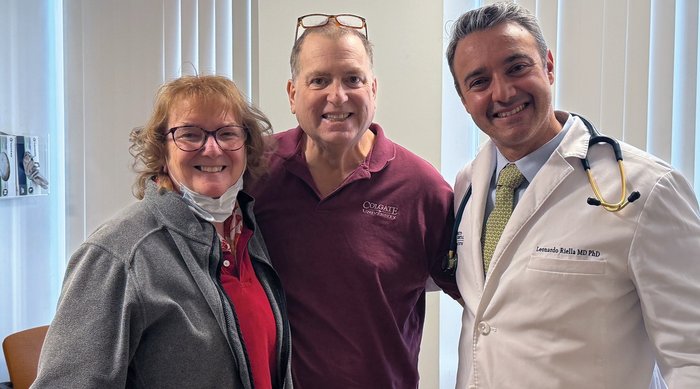
After the transplant, Tim took new monoclonal antibody drugs, specifically designed to suppress immune reactions against the pig tissue, as well as standard antirejection medication.
Going from no hope, knowing I'd be on dialysis until I died, to having hope, was amazing . . . I’d read about it and it's a bit sci-fi when you’re talking about genetically editing a pig’s kidney so it sits better in me.
Before the operation, Tim spoke to Towana Looney, who’d had the same procedure in New York a few months earlier. Her kidney had fewer gene edits than Tim, whose new kidney underwent 69 gene edits to make it more compatible with the human body, and she had experienced rejection issues, eventually having to have the transplant removed.
Doctors are still unsure how many edits are necessary, but both versions of the modified pig kidneys had pig genes removed, and human genes added. It's still a very long learning curve as doctors continue to work out how much medicine each patient needs, and how many gene editing tweaks need to be done for a positive, long-term outcome.
Tim’s operation was on January 25, and doctors successfully attached the genetically modified pig kidney, which started working straight away and Tim felt instantly better.
When I did dialysis, I slept a lot and didn't feel well at all . . . now, I can get up and walk around the block and take the dog for a walk. I feel so much better. There are still a few bumps in the road because we don’t know what we’re dealing with, and there are no guarantees, but I take each day as it comes.
For Tim, a future on dialysis wasn’t a viable option, and a traditional transplant felt like years away. So a xenotransplant was the only option, and now he hopes his experience will inspire others to feel hopeful.
Getting off dialysis and living again, made such a huge difference. The whole reason I did this was to bring hope to people. I talk to as many people as I can who are on dialysis, or have had a transplant. This is cutting-edge stuff.
Initial signs of the kidney being rejected by Tim's immune system were successfully treated by a change to his medication. After six months, the blood vessels in his kidney started to become damaged and the organ became inflamed and began to fail.
Tim returned to dialysis for 82 days. In January 2026 he received a kidney from a donor, which has been working well.
A version of this interview appeared in Kidney Matters Issue 30: Autumn 2025.