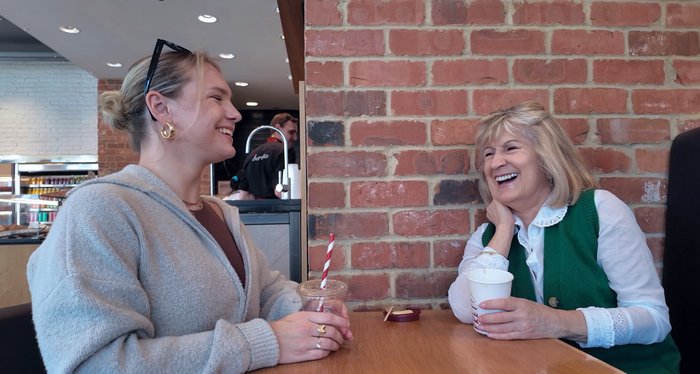
Meg meets Kidney Matters magazine editor Deb, diagnosed at a similar age in 1987, to discuss how their experiences have been both similar and very different.
When you’re in your 20s and life is just starting to get interesting, the shock, panic, and sense of loss that comes with a diagnosis of chronic kidney disease (CKD) is eased a little by knowing you can reach out to a whole community of people going through similar struggles.
But 38 years ago, when Kidney Matters editor Deborah (Deb) Duval was diagnosed, there was no internet, or mobile phones, Facebook, TikTok or Instagram community to reach out to. Deborah’s and my experiences might be nearly four decades apart, but how much has really changed?
Out of the blue diagnosis
Although I have always tried my best to put on a brave face, I’d be lying if I didn’t say that when I was suddenly, out of the blue, diagnosed with kidney failure at 23, I thought my world had collapsed.
Growing up I was active, healthy, and had barely been sick a day in my life. Gymnastics, trampolining, and calisthenics were part of my daily routine, alongside working long hours as a retail manager in the time leading up to, and during, the Covid-19 pandemic. So, when I turned up at hospital with blurry vision and was told I had just two per cent kidney function, I didn’t understand what I was being told.
I’d never heard of dialysis, and I didn’t really understand much about organ transplants. Because of Covid-19 restrictions at the time, I found myself immediately under the care of the intensive care unit (ICU). I was alone, as no visitors were allowed.
Emotional rollercoaster
It didn’t take long for me to realise that kidney disease is a rollercoaster of emotions. Top of my panic list was an overwhelming feeling of isolation. When I recently met up with Deb, I learned that when she was first diagnosed with kidney disease at a similar age, it was even more isolating and more misunderstood.
Deb was diagnosed in 1987. Recently married, she was working full-time at IBM where her salary paid most of the household bills. She described walking into hospital one day, feeling unusually tired, but ready to embrace an exciting career and family life; one that involved writing children’s books in all the wonderful chaos that marriage and having several children would bring.
But, in less than an hour, she walked out with those dreams and aspirations in tatters:
There was no internet then, no kidney community, and no information. I felt completely alone and walked out of hospital that day with one piece of badly photocopied information explaining what dialysis looked like. For some reason, the scrap of information I had in my hand made me feel weirdly ashamed of my diagnosis. As if I didn’t matter.
Different, but the same
As Deb and I chatted, and despite being decades apart in age, we found ourselves nodding along to each other’s stories. There’s something universal about the way kidney failure flips your life upside down. Our paths also reflect just how far things have come, but, in some ways, how far there’s still left to go.
When Deb was first told she had kidney disease, she had to piece together what it meant by making trips to the library to discover what impact the diagnosis might have on her life. Even the diet advice she was given was grim; she recalls surviving on white toast and grilled chicken, staring at a fridge poster explaining all the things she couldn’t eat.
For me, the problem wasn’t a lack of information, it was the overwhelming, clinical way it was delivered. No one took the time to explain what any of it meant or what came next. I was a 23-year-old on a kidney ward surrounded by much older patients and I felt like an outsider at a party I had been forced to attend. Deb and I both started our kidney journeys on peritoneal dialysis. She remembers that as whole rooms in her little cottage filled up with boxes of dialysate and medical paraphernalia, she felt there was nobody to talk to who would understand what was happening. Her life shrank to one almost exclusively lived behind closed doors.
Although I still struggled with my body getting weaker and my days revolving around medications, fluid limits, and exhaustion, I had the privilege of being born in the digital era. Through TikTok and Instagram, I found a world of people who understood what I was going through – young adults on dialysis, people waiting for a transplant, others who had just been diagnosed, and suddenly, I wasn’t alone anymore.
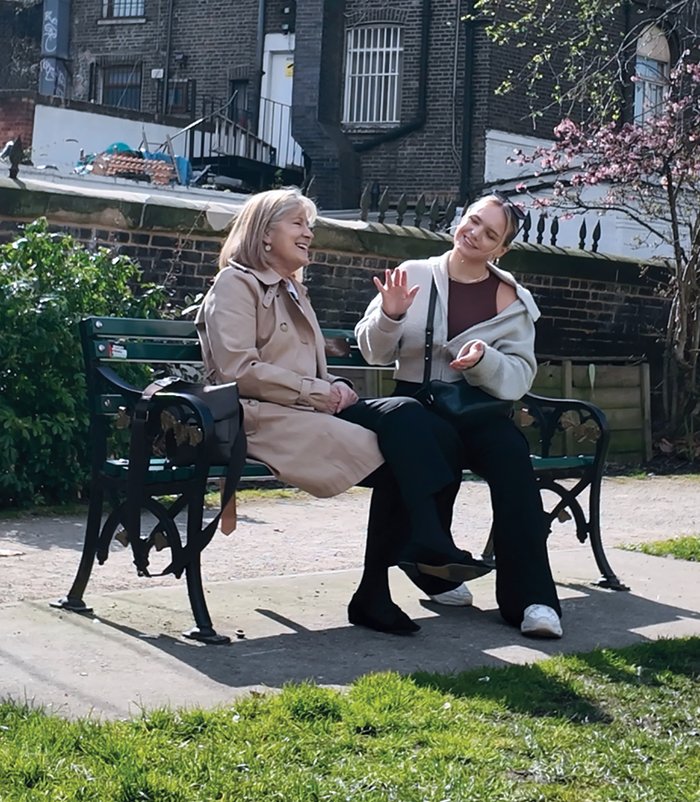
"There was no kidney community back then,” explains Deb. “Nobody really talked about it.” And yet, in the absence of connection, it spurred Deb on to start writing, reflecting on what it meant to be a woman in kidney failure and hoping things would be different for the next generation – my generation. I realise now that what Deb quietly longed for back then – representation, awareness and solidarity – is something I now carry forward by sharing my story online.
In April 2023, after nearly two years of daily dialysis, I received a kidney from my brother. My recovery went better than I could’ve imagined, as within less than a week, I was out of hospital, cautiously celebrating new beginnings.
Deb and I both agree kidney care has come a long way, thanks to charities like Kidney Care UK, but there’s still a lot to do. Public awareness, mental health support, and understanding the reality of life after a transplant, or when a transplant fails, are areas that still need a focus.
We have found our tribe
Living with kidney failure can be a humbling experience, but it also connects us to a community of people who understand what living with kidney disease means. Sadly, it’s one that’s visibly growing with every passing year. In 50 years, I hope a young person will read our stories and smile – not because the struggle is the same, but because it is not.
This article first appeared in the Summer 2025 edition of Kidney Matters magazine.