What is kidney transplantation?
Kidney transplantation is a treatment for kidney failure,which is when your kidneys stop working well enough to keep you healthy.
A kidney transplant is an operation to put a healthy kidney from someone else (the donor) into a person with kidney failure (the recipient).
What is the transplant list?
Patients who are suitable for a kidney transplant, and who have completed their assessment tests, go on a national waiting list.
People on this list are waiting for a kidney to be donated by someone who has died (deceased donor).
The transplant waiting list is a matching system rather than a queue. When a kidney becomes available, it is allocated to the person on the waiting list who is most suitable. This is known as the best match.
How do I get on the transplant list?
Your kidney team will talk to you about whether a kidney transplant could be a treatment option for you. Not everyone will be suitable for a transplant.
You need to be reasonably healthy to have the operation and for your body to cope with medications you will need to take for the rest of your life to prevent rejection of the new kidney.
You will need to have a number of tests, known as a ‘work-up’, to check you are healthy enough to have a transplant and to help match you with the best donated kidney. Your doctor will tell you if the tests show that you are not currently healthy enough for a transplant.
They will let you know if there is anything you can do to improve your health or whether another form of treatment is more suitable. Your kidney team will also make sure you will be able to cope with the emotional aspects of your transplant.
You can only join the transplant waiting list if you are already receiving or will need to start dialysis within a year. This is to ensure that you get the most benefit from the transplant and that transplants are allocated to those most in need.

Can I only receive a transplant from a deceased donor?
No, you may also be able to receive a transplant from a living donor. Most people who choose to donate a kidney do this to help a family member or close friend. For example, a parent may wish to give a kidney to their child. This is called a directed donation. It is also possible to give a kidney to a stranger and this is called non-directed altruistic donation. Talk to your kidney team about this, or see our information on donating a kidney through living kidney donation.
How are donors and recipients matched?
Ideally, the kidney donor and kidney recipient’s blood type should match. Human leukocyte antigen (HLA) typing is used to match donors and recipients for transplants. Your HLA markers, found on the outside of your blood cells, should be reasonably similar, but don’t need to match completely.
When a potential kidney is found, your blood will be tested against the donor’s to check that they match and to reduce the chance of your body rejecting the kidney.
How long will I have to wait for a transplant?
The average waiting time is around two to three years. Some people can be called with a match within a few days of joining the kidney transplant list, while others may have to wait many years.
According to figures from NHS Blood and Transplant, people of Asian heritage account for 18% of the transplant waiting list, but only 3% of deceased donors. People of Black heritage account for 10% of the waiting list and only 2% of deceased donors. Organ matching is better when the donor and recipient are from the same ethnic background. As fewer donors are from a non-White background, people of Asian and Black heritage tend to have to wait longer for a transplant because it can take longer to find a suitable match.
You may also have to wait longer if you have a rare blood group or if you are sensitised. Sensitisation happens during pregnancies, after having a blood transfusion or if you have had a previous transplant. Being sensitised means that there is more chance of your body rejecting a transplant kidney if it is not a very close match.
You will be tested for the amount of sensitisation you have when you start the transplant assessment process.
What happens if I’m away from home?
You could receive a phone call to invite you for a kidney transplant at any time once you have been activated on the waiting list.
If you are ill, or go away on holiday, you may need to be temporarily suspended from the list.
If you receive dialysis abroad, you may need to remain suspended from the waiting list for a few months after your return. This is because in some countries there is an increased risk of being infected with a virus such as hepatitis or HIV. You will usually be reactivated on the kidney transplant waiting list as soon as virology tests are found to be negative.

Do I have to be on dialysis before a transplant?
You may be able to have a kidney transplant before you need to have dialysis. This is called a pre-emptive transplant. This is more likely to be possible if you have a friend or relative willing to donate a kidney to you, as the surgery can then be planned in advance.
How long will a kidney transplant last?
On average, a kidney transplant from a living donor will last for 20–25 years, while a kidney from a deceased donor will last 15–20 years.
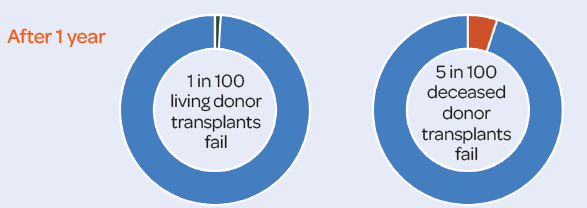
99 in 100 living donor transplants and 95 in 100 deceased donor transplants are still working after 1 year.
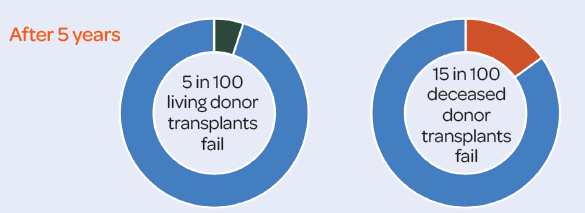
95 in 100 living donor transplants and 85 in 100 deceased donor transplants are still working after 5 years.
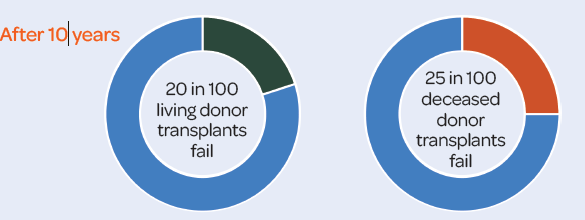
80 in 100 living donor transplants and 75 in 100 deceased donor transplants are still working after 10 years.

Will a transplant cure my kidney disease?
A successful transplant is a very good treatment for kidney failure. However, it will not cure the underlying cause of your kidney disease. Some kidney diseases can come back in the transplanted kidney and your kidney doctor will discuss this with you.
Improvement in your kidney function will depend on many factors, such as the quality of the kidney you are given and any other conditions you may have. Many patients will still have some form of kidney disease, but a transplant aims to improve your quality of life and reduce the likelihood of you needing dialysis. After a transplant, you will need to take medicines called immunosuppressants to stop your immune system, which is the body’s natural defence system, from rejecting the new kidney. You will need to take these medicines for the rest of your life.
Can I have more than one kidney transplant?
Yes – however, you may have to wait longer if you have had a transplant before as it becomes harder to find a match as you may be more sensitised. You will need to go through the same tests again to make sure you are healthy enough to receive another kidney.
Where can I find out more information?

Publication date: 11/2026
Review date: 11/2029